Design & Planning As Built Client Portal 01386 365145 Book a Test
Part L · As Built Testing

Air Tightness Testing
First time, every time.

ATTMA-accredited blower door testing for new build residential and commercial buildings. Pre-test guidance included — we help you pass before we arrive on site.

24 hr
report turnaround
after test
From £95
+VAT per dwelling
no hidden fees

Book a Test

Same-week slots available across the Midlands & South West

Thanks — we'll confirm availability and pricing within one working day.

Measuring how much air leaks through your building's fabric.
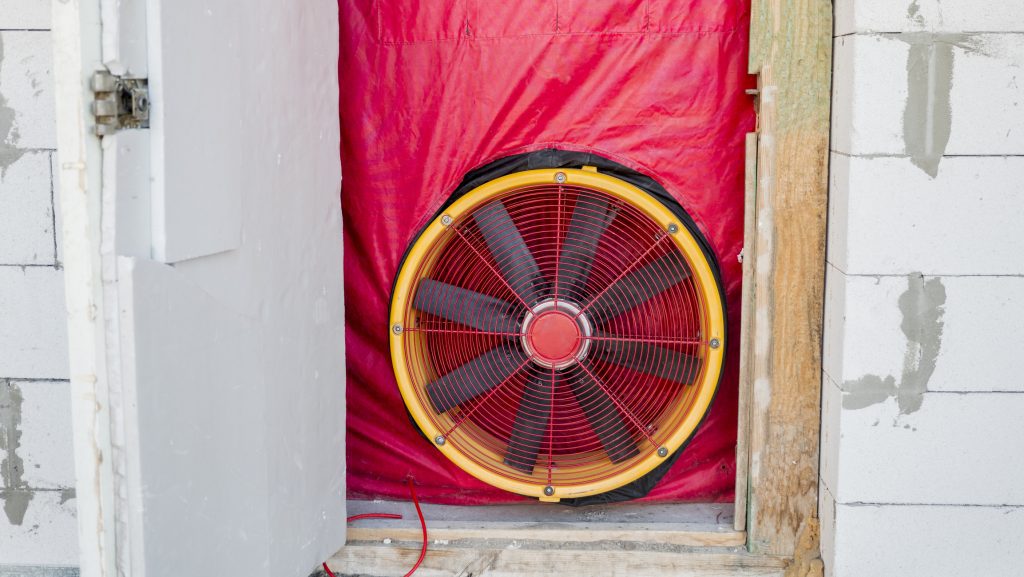
Air tightness test blower door equipment

Air tightness testing — also called air leakage testing or a pressure test — measures the amount of uncontrolled air escaping through gaps, poor seals, and penetrations in a building's envelope. It is expressed as cubic metres of air per hour per square metre of envelope area at 50 Pascals of pressure (m³/h.m² @50Pa).

Part L of the Building Regulations requires all new build residential and commercial properties in England and Wales to demonstrate an acceptable air permeability result as part of achieving building control sign-off. The result is also a direct input into your as-built SAP calculation — a poor result can push a dwelling below its compliance threshold.

Beyond compliance, a well-sealed building retains heat more effectively, reduces energy bills for occupants, and minimises the risk of condensation and moisture ingress through the building fabric. Air tightness is one of the highest-impact, lowest-cost improvements available during construction — the detail work costs little; a failed test and retesting does.

Current pass benchmark

8 m³/h.m²
maximum air permeability at 50 Pascals — Part L 2021, England & Wales
Your SAP target may be tighter. The notional dwelling in SAP 10 assumes a design air permeability of 5 m³/h.m². If your design stage SAP used a tighter figure to achieve compliance, the as-built test must match or beat it — or your EPC will fail. We flag this risk before we test.
Commercial buildings (Part L Vol. 2) have a default maximum of 10 m³/h.m², though your SBEM calculation may require a lower target.

What happens on the day of your air test.

A typical single-dwelling test takes around 90 minutes on site. We work with your site team to minimise disruption and move efficiently through the process.

01
Pre-test preparation check
We walk the building with your site team, confirming all vents are temporarily sealed, internal doors are open, and the envelope is ready. We flag any obvious problem areas before the fan is fitted.
02
Blower door installation
A calibrated fan unit is fitted to an external doorframe. The fan depressurises the building to a series of reference pressures, typically between 10–60 Pa, while airflow and pressure readings are recorded.
03
Measurement & analysis
BSRIA TM23 methodology is used to calculate the air permeability from the pressure and flow readings. Results are compared against your Part L compliance target and SAP design value.
04
Report & certificate
Test report issued within 24 hours. If the building passes, a compliance certificate is provided for Building Control submission. If it fails, we provide a written list of likely causes and remediation advice.

Getting your building ready — and avoiding a re-test.

The most common cause of a failed air test isn't poor construction — it's poor preparation on the day. Unsealed service penetrations, open trickle vents, and incomplete mastic around window reveals are the usual culprits, and all are fixable before we arrive.

We provide all clients with a pre-test preparation checklist at the point of booking. For larger developments, we strongly recommend a pre-test inspection once the building is watertight but before internal finishes are applied — at that stage, any leakage paths are still visible and accessible, making remediation cheap and fast.

For projects targeting very low air permeability (under 3 m³/h.m²), or those pursuing Passivhaus certification, early-stage pressure testing during construction is standard practice. We can advise on a testing programme appropriate for your project.

Pre-test checklist

All doors & windows fitted and closed External openings must be fully operational and properly weather-sealed.
Service penetrations sealed Pipes, cables, and ducts passing through the envelope must be sealed with appropriate materials.
Skirting & architraves fitted Junctions between floor, wall, and ceiling finishes should be complete and sealed.
Trickle vents & extract fans temporarily sealed Intentional ventilation openings must be closed or blocked for the duration of the test.
Internal doors fixed open Allows even air distribution throughout the building during pressurisation.
SAP design value confirmed We need to know your design stage air permeability target to check the result against it.
"I have just used Build Envelope for Air Tightness Testing on our new build property and cannot thank them enough for the timely and professional manner in which the work was completed. I would not hesitate in using them again and would fully recommend them. Absolutely first class."
SB
Stephen B.
Self-Build, Worcester
ATTMA-accredited — certificates accepted by Building Control
Our accreditation means your test certificates are legally valid for Part L compliance sign-off with all local Building Control authorities in England and Wales.
Pre-test guidance as standard
We send a preparation checklist at booking and are available to answer questions before the test day. Most re-tests are avoidable — we'd rather help you pass first time.
SAP-coordinated testing
If we're handling your SAP calculations too, we flag your design-stage permeability target before the test and feed your result directly into the as-built assessment — no delays, no miscommunication.

How many units need to be tested?

Part L sets out sampling requirements for developments with multiple dwellings. The rules vary by development size and whether a consistent construction type is used throughout.

Single dwellings
Every unit tested
For one or two-dwelling developments, each individual dwelling must be tested and certified separately as part of the Building Control sign-off process.
No sampling applies — one result per dwelling required.
Small developments (3–10 units)
Minimum 3 units or 50%
Developments of between 3 and 10 similar units of the same construction type may test a sample — whichever is greater of 3 units or 50% of the total number of dwellings.
If a sampled unit fails, all remaining units in that type must be tested.
Larger developments (11+ units)
Minimum 3 units per type
For larger schemes with consistent construction, a minimum of 3 units per dwelling type may be tested as a representative sample. Separate types or construction details require separate sampling groups.
Early engagement lets us plan the testing programme across your completion schedule.

Local ATTMA-accredited testers across the Midlands and South West.

Same-week availability across our core service areas. Our testers know local building control teams and can coordinate testing around your completion programme.

Birmingham & West Midlands
Air tightness testing for new builds, apartments, and commercial properties across Birmingham, Solihull, Coventry, Wolverhampton, and the wider West Midlands. Regular slots available with fast report turnaround.
Bristol & South West
Blower door testing and Part L compliance across Bristol, Bath, South Gloucestershire, and the surrounding South West region. Pre-test guidance included as standard.
Worcestershire
Based in Worcester — our home county with the fastest response times. Air tightness testing across Malvern, Droitwich, Evesham, Bromsgrove, and Redditch.
Gloucestershire
Air permeability testing for residential and commercial projects across Cheltenham, Gloucester, Stroud, Tewkesbury, and the Cotswolds. Certificates accepted by all local Building Control authorities.
Oxfordshire
Part L air tightness testing for new homes and developments across Oxford, Banbury, Bicester, Witney, and the wider Oxfordshire area. Same-week slots frequently available.
Wider England & Wales
As ATTMA-accredited testers, our air tightness certificates are valid across the whole of England and Wales. We regularly test on projects outside our core regions — contact us wherever your site is.

Looking for air tightness testing near you? Whether you're a developer with a multi-plot scheme in Birmingham, a self-builder in the Cotswolds, or a contractor with a commercial unit in Bristol — our ATTMA-accredited testers deliver compliant results from £95+VAT with no hidden fees. Call 01386 365145 or email us to book.

Common questions about air tightness testing.

Pricing starts from £95+VAT for a single dwelling. Larger or multi-unit developments are quoted based on the number of units, construction type, and location. For developments requiring multiple tests we provide a programme quote covering all required units.

There are no hidden fees — the quoted price includes travel, the test, and the compliance certificate or failure report.

If the result exceeds your compliance target, we provide a written report identifying the most likely causes of the excess air leakage and recommended remedial actions. Common causes include unsealed service penetrations, gaps around loft hatches, poorly sealed window reveals, and incomplete floor-to-wall junctions.

Once remediation has been carried out, a re-test is arranged. We try to accommodate re-tests quickly to minimise delays to your completion programme. Re-test pricing is available on request.

Your air permeability test result is a required input for the as-built SAP calculation. The design stage SAP will have assumed a target air permeability value — if your tested result is worse than that assumed value, the as-built SAP score will be lower, and may push the dwelling below its compliance threshold.

This is why we always check your design stage SAP assumptions before testing. If there is a risk of non-compliance, we flag it so you can investigate potential remediation before the formal test is conducted.

Yes. We test residential buildings under Part L Volume 1 and commercial buildings under Part L Volume 2. The methodology differs slightly — commercial testing follows CIBSE TM23 guidance and uses a different envelope area calculation — but the process is similar.

Commercial permeability requirements are set at 10 m³/h.m² by default, but your SBEM calculation may require a tighter target. We confirm the applicable target before testing.

Mechanical Ventilation with Heat Recovery (MVHR) systems are commonly specified in highly airtight buildings to maintain indoor air quality without the heat losses associated with natural ventilation. The system extracts stale air and supplies fresh air simultaneously, using a heat exchanger to recover warmth from the outgoing air.

During the air tightness test, the MVHR supply and extract points are temporarily sealed so they don't affect the measured air leakage result. The system itself doesn't influence the test, but buildings with MVHR typically have a tighter air permeability target, so preparation and sealing quality matters more.

Yes. For projects with a tight permeability target, or where the client wants confidence before the formal test, we can carry out a pre-test inspection and informal pressure check during construction — typically once the building is plastered and before floor finishes are laid.

At this stage any leakage paths are still accessible, and remediation is straightforward and inexpensive. This is particularly valuable on Passivhaus or near-Passivhaus projects, or on first-of-type plots on a larger development where the result will inform remediation across other units.

Same-week availability

Ready to book your air tightness test?

Tell us your project type and location and we'll confirm availability, pricing, and your SAP design permeability target — all before you commit.

Book a Test →