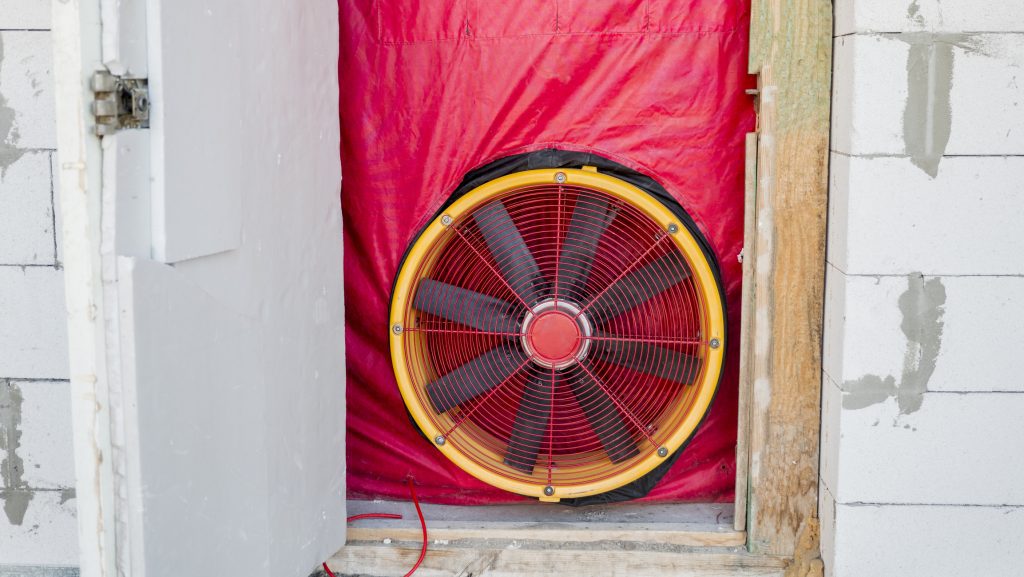
ATTMA-accredited blower door testing across Bristol, Bath, South Gloucestershire, Weston-super-Mare, Taunton and Bridgwater. Accessible via the M5 corridor with regular testing slots available.
Same-week slots available across Bristol & Somerset
Thanks — we'll confirm availability and pricing within one working day.
Bristol and the wider Somerset region are experiencing significant residential and commercial development, with local authorities increasingly focused on energy performance and Part L compliance. We provide regular air tightness testing across the South West, travelling via the M5 corridor from our Worcester base. This means we can service Bristol, Bath, South Gloucestershire, North Somerset, and the Somerset towns of Taunton, Bridgwater, and Weston-super-Mare efficiently and cost-effectively.
Air tightness testing — also called air leakage testing or a pressure test — measures the amount of uncontrolled air escaping through gaps, poor seals, and penetrations in a building's envelope. It is expressed as cubic metres of air per hour per square metre of envelope area at 50 Pascals of pressure (m³/h.m² @50Pa).
Part L of the Building Regulations requires all new build residential and commercial properties in England and Wales to demonstrate an acceptable air permeability result as part of achieving building control sign-off. The result is also a direct input into your as-built SAP calculation — a poor result can push a dwelling below its compliance threshold.
Beyond compliance, a well-sealed building retains heat more effectively, reduces energy bills for occupants, and minimises the risk of condensation and moisture ingress through the building fabric. Air tightness is one of the highest-impact, lowest-cost improvements available during construction — the detail work costs little; a failed test and retesting does.
A typical single-dwelling test takes around 90 minutes on site. We work with your site team to minimise disruption and move efficiently through the process.
The most common cause of a failed air test isn't poor construction — it's poor preparation on the day. Unsealed service penetrations, open trickle vents, and incomplete mastic around window reveals are the usual culprits, and all are fixable before we arrive.
We provide all clients with a pre-test preparation checklist at the point of booking. For larger developments, we strongly recommend a pre-test inspection once the building is watertight but before internal finishes are applied — at that stage, any leakage paths are still visible and accessible, making remediation cheap and fast.
For projects targeting very low air permeability (under 3 m³/h.m²), or those pursuing Passivhaus certification, early-stage pressure testing during construction is standard practice. We can advise on a testing programme appropriate for your project.
Blower door testing and Part L compliance across Bristol, Bath, and the wider South West region.
We also cover: Worcestershire, Birmingham & West Midlands, Gloucestershire, Warwickshire
Pricing starts from £95+VAT for a single dwelling. Projects across Bristol, Bath, South Gloucestershire, and Somerset are quoted based on the number of units, construction type, and location.
There are no hidden fees — the quoted price includes travel, the test, and the compliance certificate or failure report.
If the result exceeds your compliance target, we provide a written report identifying the most likely causes of the excess air leakage and recommended remedial actions. Common causes include unsealed service penetrations, gaps around loft hatches, poorly sealed window reveals, and incomplete floor-to-wall junctions.
Once remediation has been carried out, a re-test is arranged. We try to accommodate re-tests quickly to minimise delays to your completion programme.
Your air permeability test result is a required input for the as-built SAP calculation. The design stage SAP will have assumed a target air permeability value — if your tested result is worse than that assumed value, the as-built SAP score will be lower, and may push the dwelling below its compliance threshold.
This is why we always check your design stage SAP assumptions before testing. If there is a risk of non-compliance, we flag it so you can investigate potential remediation before the formal test is conducted.
Yes. We test residential buildings under Part L Volume 1 and commercial buildings under Part L Volume 2. Bristol has a thriving commercial development market and we regularly test offices, retail units, and mixed-use schemes across the city and surrounding areas.
Commercial permeability requirements are set at 10 m³/h.m² by default, but your SBEM calculation may require a tighter target. We confirm the applicable target before testing.
Yes. We cover the whole of the Bristol and Somerset region including Bristol, Bath, South Gloucestershire, North Somerset, Weston-super-Mare, Taunton, Bridgwater, Frome, and Yeovil. The M5 corridor makes the entire region easily accessible from our Worcester base.
We travel to Bristol and the South West via the M5 corridor and typically have same-week availability. For urgent requests we can often accommodate next-day testing. Contact us on 01386 365145 to check current availability.
Yes. For projects with a tight permeability target, or where the client wants confidence before the formal test, we can carry out a pre-test inspection and informal pressure check during construction — typically once the building is plastered and before floor finishes are laid.
At this stage any leakage paths are still accessible, and remediation is straightforward and inexpensive. This is particularly valuable on Passivhaus or near-Passivhaus projects, or on first-of-type plots on a larger development.
Tell us your project type and location and we'll confirm availability, pricing, and your SAP design permeability target — all before you commit.