Design & Planning As Built Client Portal Part L Photo Evidence 01386 365145 Book a Test
Part L · As Built Testing

Air Tightness Testing
in Gloucestershire

ATTMA-accredited blower door testing across Cheltenham, Gloucester, Stroud, Tewkesbury, Cirencester and the Cotswolds. Experienced with heritage builds and conservation area properties.

ATTMA
accredited testers
certificates accepted nationwide
24 hr
report turnaround
after test
From £95
+VAT per dwelling
no hidden fees

Book a Test

Same-week slots available across Gloucestershire

Thanks — we'll confirm availability and pricing within one working day.

Accreditations
ATTMA Registered
BSRIA Compliant
Part L 2021

ATTMA-accredited testing from the Cotswolds to the Forest of Dean.
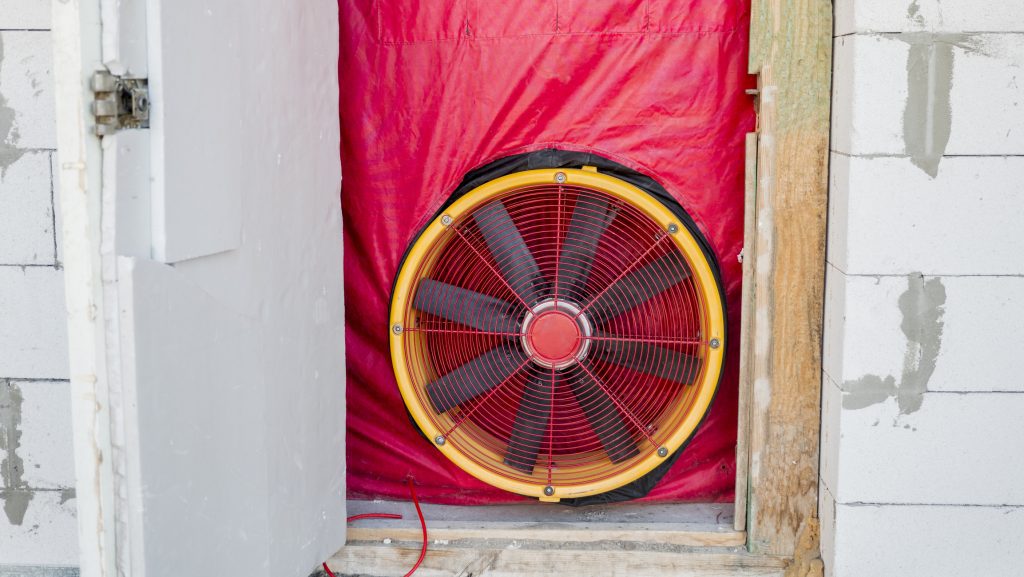
Air tightness test blower door equipment in Gloucestershire

Gloucestershire presents a distinctive mix of development types — from new-build housing estates around Cheltenham and Gloucester to sensitive barn conversions and new dwellings within the Cotswolds Area of Outstanding Natural Beauty. We understand the particular challenges that come with testing in conservation areas, where building materials, construction methods, and planning constraints can all affect airtightness outcomes. Our Worcester base is a neighbouring county, keeping travel times short and response times fast.

Air tightness testing — also called air leakage testing or a pressure test — measures the amount of uncontrolled air escaping through gaps, poor seals, and penetrations in a building's envelope. It is expressed as cubic metres of air per hour per square metre of envelope area at 50 Pascals of pressure (m³/h.m² @50Pa).

Part L of the Building Regulations requires all new build residential and commercial properties in England and Wales to demonstrate an acceptable air permeability result as part of achieving building control sign-off. The result is also a direct input into your as-built SAP calculation — a poor result can push a dwelling below its compliance threshold.

Beyond compliance, a well-sealed building retains heat more effectively, reduces energy bills for occupants, and minimises the risk of condensation and moisture ingress through the building fabric. Air tightness is one of the highest-impact, lowest-cost improvements available during construction — the detail work costs little; a failed test and retesting does.

Current pass benchmark

8 m³/h.m²
maximum air permeability at 50 Pascals — Part L 2021, England & Wales
Your SAP target may be tighter. The notional dwelling in SAP 10 assumes a design air permeability of 5 m³/h.m². If your design stage SAP used a tighter figure to achieve compliance, the as-built test must match or beat it — or your EPC will fail. We flag this risk before we test.
Commercial buildings (Part L Vol. 2) have a default maximum of 10 m³/h.m², though your SBEM calculation may require a lower target.

What happens on the day of your air test.

A typical single-dwelling test takes around 90 minutes on site. We work with your site team to minimise disruption and move efficiently through the process.

01
Pre-test preparation check
We walk the building with your site team, confirming all vents are temporarily sealed, internal doors are open, and the envelope is ready. We flag any obvious problem areas before the fan is fitted.
02
Blower door installation
A calibrated fan unit is fitted to an external doorframe. The fan depressurises the building to a series of reference pressures, typically between 10–60 Pa, while airflow and pressure readings are recorded.
03
Measurement & analysis
BSRIA TM23 methodology is used to calculate the air permeability from the pressure and flow readings. Results are compared against your Part L compliance target and SAP design value.
04
Report & certificate
Test report issued within 24 hours. If the building passes, a compliance certificate is provided for Building Control submission. If it fails, we provide a written list of likely causes and remediation advice.

Getting your building ready — and avoiding a re-test.

The most common cause of a failed air test isn't poor construction — it's poor preparation on the day. Unsealed service penetrations, open trickle vents, and incomplete mastic around window reveals are the usual culprits, and all are fixable before we arrive.

We provide all clients with a pre-test preparation checklist at the point of booking. For larger developments, we strongly recommend a pre-test inspection once the building is watertight but before internal finishes are applied — at that stage, any leakage paths are still visible and accessible, making remediation cheap and fast.

For projects targeting very low air permeability (under 3 m³/h.m²), or those pursuing Passivhaus certification, early-stage pressure testing during construction is standard practice. We can advise on a testing programme appropriate for your project.

Pre-test checklist

All doors & windows fitted and closedExternal openings must be fully operational and properly weather-sealed.
Service penetrations sealedPipes, cables, and ducts passing through the envelope must be sealed with appropriate materials.
Skirting & architraves fittedJunctions between floor, wall, and ceiling finishes should be complete and sealed.
Trickle vents & extract fans temporarily sealedIntentional ventilation openings must be closed or blocked for the duration of the test.
Internal doors fixed openAllows even air distribution throughout the building during pressurisation.
SAP design value confirmedWe need to know your design stage air permeability target to check the result against it.

Air tightness testing across Gloucestershire.

Testing for residential and commercial projects across Gloucestershire including conservation areas in the Cotswolds.

Cheltenham & Bishops Cleeve
Air tightness testing across Cheltenham borough and surrounding developments.
Gloucester, Quedgeley & Brockworth
Covering Gloucester city and the south-east growth areas.
Stroud, Nailsworth & Dursley
Testing across the Stroud valleys and surrounding areas.
Tewkesbury, Winchcombe & Ashchurch
North Gloucestershire including the Tewkesbury borough growth areas.
Cirencester, Tetbury & the Cotswolds
Air tightness testing across the Cotswold district including conservation area properties.
Wider England & Wales
As ATTMA-accredited testers, our certificates are valid nationally. Contact us wherever your site is.

We also cover: Worcestershire, Birmingham & West Midlands, Bristol & Somerset, Warwickshire

Common questions about air tightness testing in Gloucestershire.

Pricing starts from £95+VAT for a single dwelling. Projects across Gloucestershire including Cheltenham, Gloucester, Stroud, Tewkesbury, Cirencester, and the Cotswolds are quoted based on the number of units, construction type, and location.

There are no hidden fees — the quoted price includes travel, the test, and the compliance certificate or failure report.

If the result exceeds your compliance target, we provide a written report identifying the most likely causes of the excess air leakage and recommended remedial actions. Common causes include unsealed service penetrations, gaps around loft hatches, poorly sealed window reveals, and incomplete floor-to-wall junctions.

Once remediation has been carried out, a re-test is arranged. We try to accommodate re-tests quickly to minimise delays to your completion programme.

Yes. The Cotswolds and wider Gloucestershire have a high proportion of conservation areas and listed buildings. While testing methodology remains the same, we understand the particular challenges of working with heritage properties including stone construction, lime mortar joints, and traditional building methods.

We work sensitively with conservation officers and building control where required, and can advise on realistic permeability targets for conversion and renovation projects.

Your air permeability test result is a required input for the as-built SAP calculation. The design stage SAP will have assumed a target air permeability value — if your tested result is worse than that assumed value, the as-built SAP score will be lower, and may push the dwelling below its compliance threshold.

This is why we always check your design stage SAP assumptions before testing. If there is a risk of non-compliance, we flag it so you can investigate potential remediation before the formal test is conducted.

Yes. We cover the whole of Gloucestershire including Gloucester, Cheltenham, Stroud, Tewkesbury, Cirencester, the Forest of Dean, Dursley, and all areas within the Cotswolds AONB. Gloucestershire is a neighbouring county to our Worcester base, so travel times are short and we can often offer same-week availability.

Gloucestershire is a neighbouring county to our Worcester base, so we can respond quickly. We typically have same-week availability and can often accommodate next-day testing for urgent requests. Contact us on 01386 365145 to check current availability.

Yes. For projects with a tight permeability target, or where the client wants confidence before the formal test, we can carry out a pre-test inspection and informal pressure check during construction — typically once the building is plastered and before floor finishes are laid.

At this stage any leakage paths are still accessible, and remediation is straightforward and inexpensive. This is particularly valuable on Passivhaus or near-Passivhaus projects, or on first-of-type plots on a larger development.

Same-week availability

Ready to book your air tightness test in Gloucestershire?

Tell us your project type and location and we'll confirm availability, pricing, and your SAP design permeability target — all before you commit.

Book a Test →