Accredited airborne and impact sound testing across Cheltenham, Gloucester, Stroud, Tewkesbury and the Cotswolds. Reports within 24 hours. Can be combined with air tightness testing.
Same-week slots available across Gloucestershire
Thanks — we'll confirm availability and pricing within one working day.
Gloucestershire has a diverse development market — from apartment schemes in Cheltenham and Gloucester to barn conversions and new builds across the Cotswolds. We travel from our Worcester base in under 45 minutes, maintaining regular testing slots across the county. Our certificates are accepted by all local Building Control authorities.
Sound insulation testing measures how effectively separating walls and floors prevent sound from passing between adjoining dwellings. Airborne tests measure speech and music transmission (DnT,w + Ctr in dB); impact tests measure footstep noise through floors (L'nT,w in dB).
Part E of the Building Regulations requires all new build attached dwellings, apartments, and material change-of-use conversions to demonstrate acceptable sound insulation before building control sign-off.
Beyond compliance, good sound insulation is critical for resident satisfaction. Flanking transmission, poor junction detailing, and incomplete acoustic barriers are the most common causes of failure — all preventable with the right design-stage decisions.
A typical set of airborne wall tests takes around two hours on site. We work with your site team to minimise disruption and move efficiently through the process.
The most common cause of a failed sound test isn't poor construction — it's poor preparation on the day. Incomplete finishes, temporary floor coverings, and active construction noise in adjacent areas are the usual culprits, and all are avoidable with planning.
We provide all clients with a pre-test preparation checklist at the point of booking. For larger developments, we strongly recommend a design-stage review of the separating wall and floor build-ups to identify potential flanking risks before construction begins.
Sound insulation performance is heavily influenced by construction quality at junctions. Gaps in acoustic barriers, incomplete pointing, and bridged cavities can all compromise an otherwise compliant wall or floor detail.
Regular testing slots across Gloucestershire for new builds, conversions, and apartment schemes.
We also cover: Worcestershire, Birmingham & West Midlands, Bristol & Somerset, Warwickshire
It depends on your development type. All separating walls require airborne testing. Separating floors between apartments require both airborne and impact tests. Houses do not have separating floors between dwellings, so only airborne wall tests are required for typical terraced or semi-detached houses.
If you're unsure which tests apply to your project, contact us before booking and we'll confirm based on your building type and configuration.
If a test fails, our report will include the measured result, the shortfall against the required standard, and guidance on the most likely causes. Common reasons include flanking transmission, unsealed gaps around service penetrations, incomplete skimming of party walls, or missing/incorrectly installed acoustic membranes.
In most cases we can advise on targeted remedial measures that don't require demolition of the separating element. Once remediation is complete, a re-test is arranged.
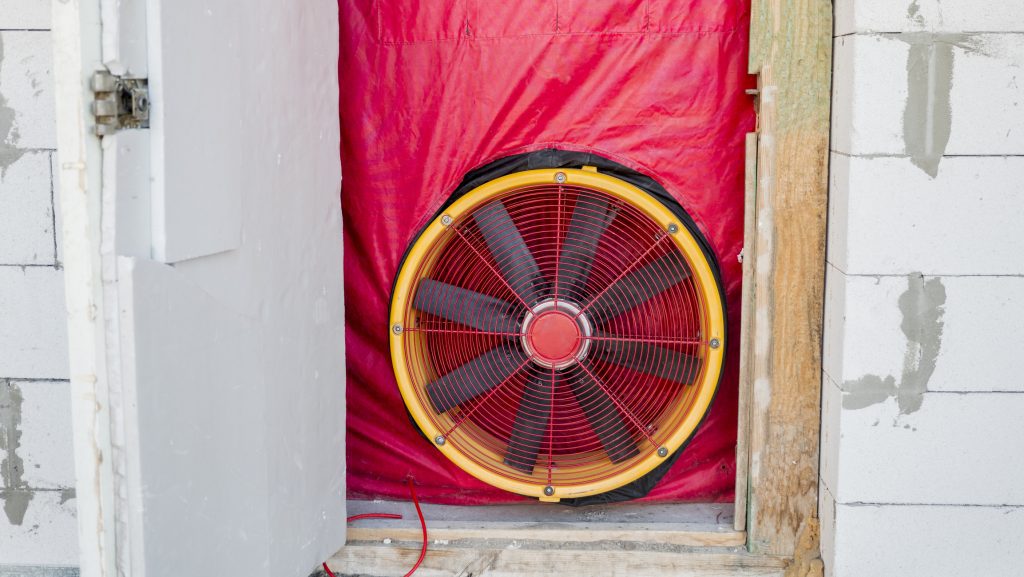
Yes — this is something we actively encourage for developments that require both tests. Combining air tightness and sound insulation testing on the same site visit reduces programme disruption, cuts travel costs, and means a single attendance covers both compliance requirements.
If you are also working with us on SAP calculations, we can align the testing visit with your as-built assessment timeline to make the completion process as efficient as possible.
Yes, conversions are one of the most common project types in Gloucestershire, particularly barn conversions across the Cotswold district. Part E applies to all material change-of-use projects, and the relaxed 43 dB airborne standard applies to conversions rather than the 45 dB new build threshold.
We have extensive experience testing converted agricultural buildings and can advise on realistic performance expectations for different construction types.
Gloucestershire is under 45 minutes from our Worcester base, so we can respond quickly. We typically have same-week availability and can often accommodate next-day testing for urgent requests. Contact us on 01386 365145 to check current availability.
A standard set of tests for a typical pair of semi-detached or terraced houses — two airborne wall tests — usually takes around two hours on site. For an apartment block requiring airborne wall tests, airborne floor tests, and impact tests, allow a full working day depending on the number of units.
We work efficiently and aim to minimise disruption to your programme. For larger developments we agree a testing schedule in advance that aligns with your completion phasing.
Yes. Part E makes a distinction between new build and material change of use (conversion) projects. The minimum performance standard for conversions is slightly relaxed — 43 dB DnTw + Ctr for airborne tests rather than 45 dB — to account for the constraints of working within an existing structure.
The test methodology and preparation requirements are the same. However, older buildings can present additional flanking risks from continuous structural elements, so it's worth discussing the specific construction with us before the test day.
Tell us your project type and location and we'll confirm availability, pricing, and testing requirements — all before you commit.