Accredited & Registered





Accredited airborne and impact sound testing across Leicester, Loughborough, Hinckley, Melton Mowbray and Market Harborough. Reports within 24 hours. Can be combined with air tightness testing.
Same-week slots available across Leicestershire
Thanks — we'll confirm availability and pricing within one working day.
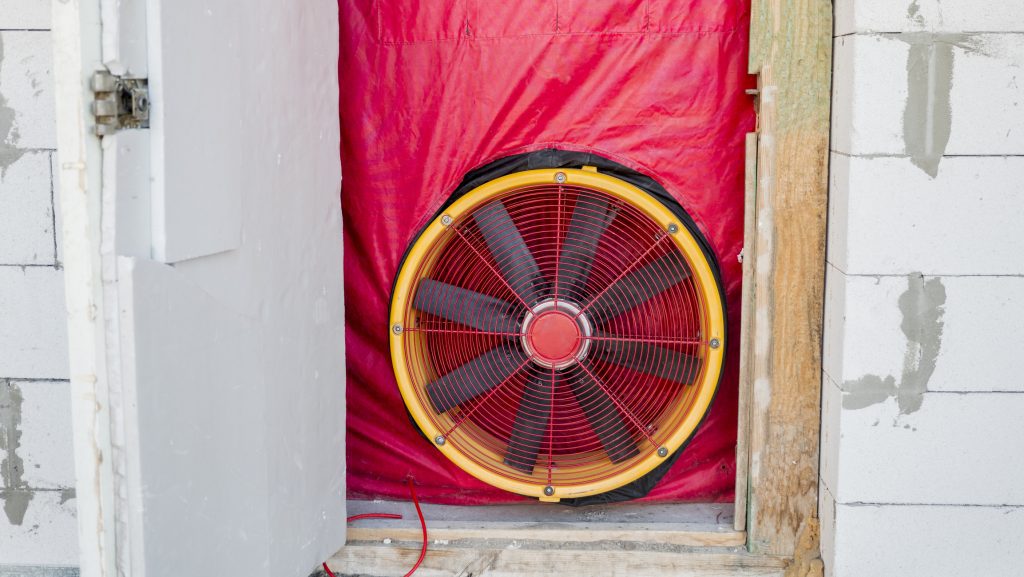
Leicestershire has one of the highest concentrations of attached and multi-occupancy housing in the Midlands. Three universities — Leicester, De Montfort and Loughborough — sustain a steady pipeline of purpose-built student accommodation and house-to-flat conversions, while new build apartment and terrace schemes continue across Leicester city, Lubbesthorpe, Loughborough, Hinckley and the county’s market towns. All of these fall under Part E, and we maintain regular testing slots across the county.
Sound insulation testing measures how effectively separating walls and floors prevent sound from passing between adjoining dwellings. Airborne tests measure speech and music transmission (DnT,w + Ctr in dB); impact tests measure footstep noise through floors (L’nT,w in dB).
Part E of the Building Regulations requires all new build attached dwellings, apartments, and material change-of-use conversions to demonstrate acceptable sound insulation before building control sign-off.
Beyond compliance, good sound insulation is one of the strongest predictors of resident satisfaction. Flanking transmission, poor junction detailing, and incomplete acoustic barriers are the most common causes of failure — all preventable with design-stage decisions and quality control.
A typical sound test takes between two and four hours on site.
Sound insulation tests are highly sensitive to the condition of separating elements and surrounding finishes. Incomplete plasterwork, missing acoustic membranes, or unsealed service penetrations can all cause a failure that would have been avoided with a finished build.
No floor coverings should be laid on separating floors before testing. Carpet and underlay can artificially improve impact test results, and Building Control will not accept results taken with coverings in place. Hard flooring can remain if it is the permanent finish.
We provide a pre-booking checklist at the point of enquiry so your site team can confirm readiness before we attend. This avoids wasted visits and re-test costs.
Regular testing slots for new builds, conversions, student accommodation, and apartments across Leicestershire.
We also cover: Worcestershire, Birmingham & West Midlands, Warwickshire, Gloucestershire, Bristol & Somerset
It depends on your development type. All separating walls require airborne testing. Separating floors between apartments require both airborne and impact tests. Houses with separating walls only (terraced or semi-detached) require airborne wall tests only.
If you're unsure which tests apply, contact us and we'll confirm based on your building type and layout.
If a test fails, our report will include the measured result, the shortfall against the required standard, and guidance on the most likely causes. Common reasons include flanking transmission, unsealed gaps around service penetrations, incomplete skimming of party walls, or missing acoustic membranes.
In most cases we can advise on targeted remedial measures that don't require demolition of the separating element. Once remediation is complete, a re-test is arranged.
Yes — this is something we actively encourage for developments that require both tests. Combining air tightness and sound insulation testing on the same site visit reduces programme disruption, cuts travel costs, and means fewer site attendances overall.
Yes. We test all Part E development types in Leicestershire, including material change-of-use conversions — which matter in Leicester, Loughborough and Oadby, where former offices, mills and large houses are regularly converted into flats and student accommodation. Conversions have a slightly relaxed minimum standard of 43 dB DnT,w + Ctr for airborne tests (compared to 45 dB for new builds) to account for the constraints of working within an existing structure.
The test methodology and preparation requirements are the same.
Yes. We cover the whole of Leicestershire including Leicester, Loughborough, Hinckley, Coalville, Melton Mowbray, Market Harborough, Ashby-de-la-Zouch, Lutterworth, Oadby, Wigston, and Shepshed. We reach the county via the M42 and M69 from our Worcester base and maintain regular testing slots across all districts.
Leicestershire sits within our wider Midlands service area, reached directly via the M42 and M69. We typically have same-week availability and can often group visits with other East Midlands sites. Contact us on 01386 365145 to check current availability.
A standard set of tests for a typical pair of semi-detached or terraced houses — two airborne wall tests — usually takes around two hours on site. For an apartment block requiring airborne wall tests, airborne floor tests, and impact tests, allow a full working day depending on the number of units.
Tell us your development type and number of units and we'll confirm which tests are required, check availability, and quote — all before you commit.